what does it mean to be polar in chemistry

A h2o molecule, a commonly used instance of polarity. Two charges are present with a negative accuse in the middle (red shade), and a positive charge at the ends (blue shade).
In chemistry, polarity is a separation of electric charge leading to a molecule or its chemical groups having an electric dipole moment, with a negatively charged cease and a positively charged finish.
Polar molecules must comprise ane or more polar bonds due to a divergence in electronegativity between the bonded atoms. Molecules containing polar bonds accept no molecular polarity if the bail dipoles cancel each other out by symmetry.
Polar molecules collaborate through dipole–dipole intermolecular forces and hydrogen bonds. Polarity underlies a number of physical properties including surface tension, solubility, and melting and boiling points.
Polarity of bonds [edit]


In a molecule of hydrogen fluoride (HF), the more electronegative atom (fluorine) is shown in xanthous. Because the electrons spend more time by the fluorine cantlet in the H−F bail, the red represents partially negatively charged regions, while blue represents partially positively charged regions.
Not all atoms attract electrons with the same forcefulness. The amount of "pull" an cantlet exerts on its electrons is called its electronegativity. Atoms with high electronegativities – such as fluorine, oxygen, and nitrogen – exert a greater pull on electrons than atoms with lower electronegativities such as alkali metals and alkali metal world metals. In a bail, this leads to diff sharing of electrons between the atoms, every bit electrons will be fatigued closer to the cantlet with the college electronegativity.
Because electrons accept a negative charge, the unequal sharing of electrons inside a bail leads to the germination of an electric dipole: a separation of positive and negative electric charge. Because the amount of charge separated in such dipoles is usually smaller than a fundamental charge, they are called fractional charges, denoted as δ+ (delta plus) and δ− (delta minus). These symbols were introduced by Sir Christopher Ingold and Dr. Edith Hilda (Usherwood) Ingold in 1926.[1] [2] The bond dipole moment is calculated past multiplying the amount of accuse separated and the distance between the charges.
These dipoles within molecules tin can interact with dipoles in other molecules, creating dipole-dipole intermolecular forces.
Classification [edit]
Bonds tin can autumn betwixt one of ii extremes – being completely nonpolar or completely polar. A completely nonpolar bail occurs when the electronegativities are identical and therefore possess a difference of zero. A completely polar bond is more than correctly called an ionic bail, and occurs when the departure betwixt electronegativities is large enough that one atom really takes an electron from the other. The terms "polar" and "nonpolar" are usually applied to covalent bonds, that is, bonds where the polarity is not complete. To determine the polarity of a covalent bond using numerical means, the difference between the electronegativity of the atoms is used.
Bond polarity is typically divided into three groups that are loosely based on the deviation in electronegativity between the two bonded atoms. According to the Pauling scale:
- Nonpolar bonds generally occur when the difference in electronegativity betwixt the two atoms is less than 0.5
- Polar bonds by and large occur when the departure in electronegativity between the ii atoms is roughly between 0.v and 2.0
- Ionic bonds more often than not occur when the departure in electronegativity between the two atoms is greater than 2.0
Pauling based this nomenclature scheme on the partial ionic character of a bond, which is an approximate role of the difference in electronegativity between the two bonded atoms. He estimated that a difference of 1.7 corresponds to 50% ionic character, so that a greater deviation corresponds to a bond which is predominantly ionic.[3]
As a quantum-mechanical clarification, Pauling proposed that the wave function for a polar molecule AB is a linear combination of wave functions for covalent and ionic molecules: ψ = aψ(A:B) + bψ(A+B−). The amount of covalent and ionic grapheme depends on the values of the squared coefficients aii and b2.[4]
Bail dipole moments [edit]

A diagram showing the bond dipole moments of boron trifluoride. δ- shows an increase in negative charge and δ+ shows an increase in positive accuse. Note that the dipole moments drawn in this diagram correspond the shift of the valence electrons equally the origin of the charge, which is opposite the direction of the actual electric dipole moment.
The bond dipole moment [5] uses the idea of electric dipole moment to measure the polarity of a chemic bail inside a molecule. It occurs whenever there is a separation of positive and negative charges.
The bond dipole μ is given by:
- .

The bail dipole is modeled as δ+ — δ– with a altitude d between the fractional charges δ+ and δ–. It is a vector, parallel to the bond axis, pointing from minus to plus,[half-dozen] equally is conventional for electrical dipole moment vectors.
Chemists often draw the vector pointing from plus to minus.[seven] This vector can be physically interpreted equally the movement undergone by electrons when the two atoms are placed a distance d apart and allowed to interact, the electrons will movement from their costless state positions to be localised more around the more electronegative atom.
The SI unit of measurement for electrical dipole moment is the coulomb–meter. This is besides large to exist practical on the molecular scale. Bond dipole moments are normally measured in debyes, represented by the symbol D, which is obtained by measuring the charge in units of x−10 statcoulomb and the altitude d in Angstroms. Based on the conversion factor of x−10 statcoulomb being 0.208 units of elementary charge, and so 1.0 debye results from an electron and a proton separated past 0.208 Å. A useful conversion gene is one D = 3.335 64×10 −30 C m.[eight]

For diatomic molecules there is only 1 (unmarried or multiple) bond then the bond dipole moment is the molecular dipole moment, with typical values in the range of 0 to 11 D. At one extreme, a symmetrical molecule such as chlorine, Cl
ii , has zilch dipole moment, while most the other extreme, gas phase potassium bromide, KBr, which is highly ionic, has a dipole moment of 10.5 D.[ix] [ folio needed ] [10] [ verification needed ]
For polyatomic molecules, there is more than one bond. The full molecular dipole moment may be approximated as the vector sum of the individual bond dipole moments. Oft bond dipoles are obtained past the reverse procedure: a known full dipole of a molecule can exist decomposed into bond dipoles. This is washed to transfer bail dipole moments to molecules that accept the same bonds, but for which the total dipole moment is non however known. The vector sum of the transferred bail dipoles gives an guess for the total (unknown) dipole of the molecule.
Polarity of molecules [edit]
While the molecules can be described equally "polar covalent", "nonpolar covalent", or "ionic", this is often a relative term, with one molecule simply being more polar or more nonpolar than another. However, the post-obit properties are typical of such molecules.
A molecule is composed of one or more chemic bonds between molecular orbitals of different atoms. A molecule may be polar either as a result of polar bonds due to differences in electronegativity every bit described to a higher place, or as a result of an asymmetric arrangement of nonpolar covalent bonds and not-bonding pairs of electrons known as a full molecular orbital.
Polar molecules [edit]

The water molecule is made up of oxygen and hydrogen, with respective electronegativities of 3.44 and 2.twenty. The electronegativity difference polarizes each H–O bond, shifting its electrons towards the oxygen (illustrated past red arrows). These effects add together as vectors to make the overall molecule polar.
A polar molecule has a internet dipole as a consequence of the opposing charges (i.due east. having fractional positive and partial negative charges) from polar bonds arranged asymmetrically. Water (HiiO) is an example of a polar molecule since information technology has a slight positive charge on one side and a slight negative accuse on the other. The dipoles do not cancel out, resulting in a net dipole. Due to the polar nature of the water molecule itself, other polar molecules are generally able to dissolve in water. The dipole moment of water depends on its country. In the gas phase the dipole moment is ≈ one.86 Debye (D),[eleven] whereas liquid water (≈ two.95 D)[12] and ice (≈ 3.09 D)[13] are higher due to differing hydrogen-bonded environments. Other examples include sugars (similar sucrose), which have many polar oxygen–hydrogen (−OH) groups and are overall highly polar.
If the bond dipole moments of the molecule do non cancel, the molecule is polar. For example, the water molecule (HtwoO) contains two polar O−H bonds in a bent (nonlinear) geometry. The bond dipole moments practise not abolish, and so that the molecule forms a molecular dipole with its negative pole at the oxygen and its positive pole midway between the 2 hydrogen atoms. In the figure each bond joins the fundamental O cantlet with a negative charge (ruby) to an H atom with a positive charge (blue).
The hydrogen fluoride, HF, molecule is polar by virtue of polar covalent bonds – in the covalent bond electrons are displaced toward the more electronegative fluorine atom.

The ammonia molecule, NH3, is polar as a result of its molecular geometry. The carmine represents partially negatively charged regions.
Ammonia, NH3, is a molecule whose three N−H bonds take simply a slight polarity (toward the more electronegative nitrogen atom). The molecule has two lone electrons in an orbital that points towards the fourth noon of an approximately regular tetrahedron, every bit predicted by the VSEPR theory. This orbital is non participating in covalent bonding; it is electron-rich, which results in a powerful dipole beyond the whole ammonia molecule.

In ozone (O3) molecules, the two O−O bonds are nonpolar (in that location is no electronegativity difference between atoms of the same element). However, the distribution of other electrons is uneven – since the central atom has to share electrons with two other atoms, merely each of the outer atoms has to share electrons with only one other atom, the central atom is more than deprived of electrons than the others (the fundamental atom has a formal charge of +i, while the outer atoms each have a formal charge of − 1⁄ii ). Since the molecule has a aptitude geometry, the result is a dipole across the whole ozone molecule.
When comparison a polar and nonpolar molecule with like tooth masses, the polar molecule in general has a higher boiling point, because the dipole–dipole interaction between polar molecules results in stronger intermolecular attractions. One common form of polar interaction is the hydrogen bond, which is likewise known as the H-bond. For example, water forms H-bonds and has a molar mass M = 18 and a boiling indicate of +100 °C, compared to nonpolar methane with M = sixteen and a boiling betoken of –161 °C.
Nonpolar molecules [edit]
A molecule may be nonpolar either when there is an equal sharing of electrons between the two atoms of a diatomic molecule or because of the symmetrical organisation of polar bonds in a more than complex molecule. For example, boron trifluoride (BF3) has a trigonal planar organisation of three polar bonds at 120°. This results in no overall dipole in the molecule.

In a molecule of boron trifluoride, the trigonal planar arrangement of three polar bonds results in no overall dipole.
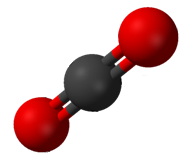
Carbon dioxide has two polar C-O bonds in a linear geometry.
Carbon dioxide (CO2) has two polar C=O bonds, but the geometry of CO2 is linear and so that the two bond dipole moments abolish and there is no net molecular dipole moment; the molecule is nonpolar.
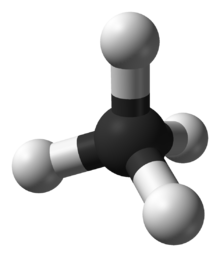
In methane, the bonds are arranged symmetrically (in a tetrahedral arrangement) so there is no overall dipole.
Examples of household nonpolar compounds include fats, oil, and petrol/gasoline. Nearly nonpolar molecules are water-insoluble (hydrophobic) at room temperature. Many nonpolar organic solvents, such every bit turpentine, are able to deliquesce not-polar substances.
In the marsh gas molecule (CHfour) the 4 C−H bonds are arranged tetrahedrally effectually the carbon atom. Each bond has polarity (though not very strong). The bonds are arranged symmetrically and so at that place is no overall dipole in the molecule. The diatomic oxygen molecule (O2) does non have polarity in the covalent bail because of equal electronegativity, hence there is no polarity in the molecule.
Amphiphilic molecules [edit]
Big molecules that have one finish with polar groups attached and another end with nonpolar groups are described as amphiphiles or amphiphilic molecules. They are good surfactants and tin aid in the formation of stable emulsions, or blends, of water and fats. Surfactants reduce the interfacial tension between oil and water by adsorbing at the liquid–liquid interface.
-

This amphiphilic molecule has several polar groups (hydrophilic, water-loving) on the right side and a long nonpolar chain (lipophilic, fatty-loving) at the left side. This gives it surfactant properties
-

A micelle – the lipophilic ends of the surfactant molecules deliquesce in the oil, while the hydrophilic charged ends remain outside in the water phase, shielding the rest of the hydrophobic micelle. In this fashion, the small oil droplet becomes water-soluble.
-
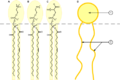
Phospholipids are effective natural surfactants that have important biological functions
Predicting molecule polarity [edit]
| Formula | Clarification | Example | Name | Dipole moment | |
|---|---|---|---|---|---|
| Polar | AB | Linear molecules | CO | Carbon monoxide | 0.112 |
| HA x | Molecules with a single H | HF | Hydrogen fluoride | one.86 | |
| A ten OH | Molecules with an OH at ane terminate | CtwoH5OH | Ethanol | i.69 | |
| O x A y | Molecules with an O at one end | H2O | Water | 1.85 | |
| N 10 A y | Molecules with an N at 1 cease | NHiii | Ammonia | one.42 | |
| Nonpolar | Atwo | Diatomic molecules of the same chemical element | Oii | Dioxygen | 0.0 |
| C x A y | Most hydrocarbon compounds | C3Hviii | Propane | 0.083 | |
| C ten A y | Hydrocarbon with center of inversion | C4Hten | Butane | 0.0 |
Determining the point group is a useful way to predict polarity of a molecule. In general, a molecule will non possess dipole moment if the individual bond dipole moments of the molecule cancel each other out. This is considering dipole moments are euclidean vector quantities with magnitude and direction, and a two equal vectors who oppose each other volition abolish out.
Any molecule with a center of inversion ("i") or a horizontal mirror airplane ("σh") will not possess dipole moments. Also, a molecule with more than one C due north axis of rotation will not possess a dipole moment because dipole moments cannot lie in more than one dimension. As a consequence of that constraint, all molecules with dihedral symmetry (D north ) will non have a dipole moment because, past definition, D point groups have two or multiple C due north axes.
Since Cane, Csouth,C∞h C due north and C nv betoken groups do non have a middle of inversion, horizontal mirror planes or multiple C n axis, molecules in one of those indicate groups volition accept dipole moment.
Electrical deflection of water [edit]
Reverse to popular misconception, the electric deflection of a stream of water from a charged object is non based on polarity. The deflection occurs because of electrically charged droplets in the stream, which the charged object induces. A stream of water can also be deflected in a uniform electrical field, which cannot exert strength on polar molecules. Additionally, after a stream of water is grounded, it can no longer be deflected. Weak deflection is even possible for nonpolar liquids.[14]
See besides [edit]
- Chemic backdrop
- Colloid
- Detergent
- Electronegativities of the elements (data folio)
- Polar point group
References [edit]
- ^ Jensen, William B. (2009). "The Origin of the "Delta" Symbol for Fractional Charges". J. Chem. Educ. 86 (v): 545. Bibcode:2009JChEd..86..545J. doi:ten.1021/ed086p545.
- ^ Ingold, C. K.; Ingold, E. H. (1926). "The Nature of the Alternate Effect in Carbon Chains. Part 5. A Discussion of Aromatic Substitution with Special Reference to Respective Roles of Polar and Nonpolar Dissociation; and a Further Study of the Relative Directive Efficiencies of Oxygen and Nitrogen". J. Chem. Soc. 129: 1310–1328. doi:x.1039/jr9262901310.
- ^ Pauling, L. (1960). The Nature of the Chemical Bail (3rd ed.). Oxford University Press. pp. 98–100. ISBN0801403332.
- ^ Pauling, L. (1960). The Nature of the Chemical Bond (third ed.). Oxford University Press. p. 66. ISBN0801403332.
- ^ Blaber, Mike (2018). "Dipole_Moments". Libre Texts. California State University.
- ^ IUPAC, Compendium of Chemical Terminology, second ed. (the "Aureate Volume") (1997). Online corrected version: (2006–) "electric dipole moment, p". doi:10.1351/goldbook.E01929
- ^ Hovick, James W.; Poler, J. C. (2005). "Misconceptions in Sign Conventions: Flipping the Electrical Dipole Moment". J. Chem. Educ. 82 (half dozen): 889. Bibcode:2005JChEd..82..889H. doi:10.1021/ed082p889.
- ^ Atkins, Peter; de Paula, Julio (2006). Physical Chemistry (eighth ed.). W.H. Freeman. p. 620 (and inside front comprehend). ISBN0-7167-8759-viii.
- ^ Physical chemical science 2nd Edition (1966) G.M. Barrow McGraw Hill
- ^ Van Wachem, R.; De Leeuw, F. H.; Dymanus, A. (1967). "Dipole Moments of KF and KBr Measured past the Molecular‐Beam Electric‐Resonance Method". J. Chem. Phys. 47 (7): 2256. Bibcode:1967JChPh..47.2256V. doi:10.1063/1.1703301.
- ^ Clough, Shepard A.; Beers, Yardley; Klein, Gerald P.; Rothman, Laurence South. (1 September 1973). "Dipole moment of water from Stark measurements of H2O, HDO, and D2O". The Journal of Chemical Physics. 59 (v): 2254–2259. Bibcode:1973JChPh..59.2254C. doi:10.1063/1.1680328.
- ^ Gubskaya, Anna V.; Kusalik, Peter G. (27 August 2002). "The total molecular dipole moment for liquid h2o". The Journal of Chemical Physics. 117 (11): 5290–5302. Bibcode:2002JChPh.117.5290G. doi:10.1063/ane.1501122.
- ^ Batista, Enrique R.; Xantheas, Sotiris S.; Jónsson, Hannes (fifteen September 1998). "Molecular multipole moments of water molecules in ice Ih". The Journal of Chemical Physics. 109 (11): 4546–4551. Bibcode:1998JChPh.109.4546B. doi:ten.1063/i.477058.
- ^ Ziaei-Moayyed, Maryam; Goodman, Edward; Williams, Peter (2000-11-01). "Electric Deflection of Polar Liquid Streams: A Misunderstood Demonstration". Journal of Chemical Education. 77 (eleven): 1520. Bibcode:2000JChEd..77.1520Z. doi:10.1021/ed077p1520. ISSN 0021-9584.
External links [edit]
- Chemical Bonding
- Polarity of Bonds and Molecules
- Molecule Polarity
Source: https://en.wikipedia.org/wiki/Chemical_polarity
Belum ada Komentar untuk "what does it mean to be polar in chemistry"
Posting Komentar