Show Me a Picture of a Baby Chicken Egg Ceptional Right
| Chicken | |
|---|---|
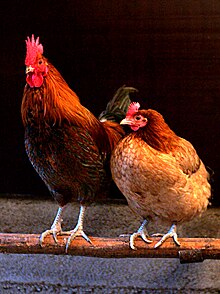 | |
| A rooster (left) and hen (right) perching on a roost | |
| Conservation status | |
| Domesticated | |
Scientific nomenclature  | |
| Kingdom: | Animalia |
| Phylum: | Chordata |
| Grade: | Aves |
| Order: | Galliformes |
| Family unit: | Phasianidae |
| Genus: | Gallus |
| Species: | G. domesticus |
| Binomial name | |
| Gallus domesticus (Linnaeus, 1758) | |
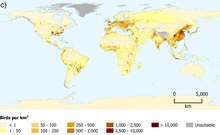 | |
| Chicken distribution | |
The chicken (Gallus domesticus) is a domesticated bird, with attributes of wild species such as the ruby-red and grey junglefowl[1] that are originally from Southeastern Asia. Rooster or cock is a term for an adult male bird, and a younger male may exist called a cockerel. A male that has been castrated is a capon. An adult female bird is called a hen and a sexually young female is called a pullet.
Originally raised for cockfighting or for special ceremonies, chickens were not kept for nutrient until the Hellenistic catamenia (4th–2d centuries BC).[2] [iii] Humans now keep chickens primarily as a source of nutrient (consuming both their meat and eggs) and as pets.
Chickens are one of the most common and widespread domestic animals, with a total population of 23.7 billion as of 2018[update],[iv] upwards from more than than xix billion in 2011.[v] There are more chickens in the world than any other bird.[5] There are numerous cultural references to chickens – in myth, folklore and religion, and in linguistic communication and literature.
Genetic studies accept pointed to multiple maternal origins in Southern asia, Southeast Asia, and Eastward Asia,[6] but the clade found in the Americas, Europe, the Eye East and Africa originated from the Indian subcontinent. From ancient Republic of india, the craven spread to Lydia in western Asia Minor, and to Greece past the 5th century BC.[seven] Fowl accept been known in Egypt since the mid-15th century BC, with the "bird that gives birth every day" having come up from the country between Syria and Shinar, Babylonia, according to the annals of Thutmose 3.[8] [9] [10]
Terminology

An adult male person is a called a 'erect' or 'rooster' (in the United States) and an adult female is chosen a 'hen'.[eleven] [12]
Other terms are:
- 'Biddy:' a newly hatched craven[13] [14]
- 'Capon:' a castrated or neutered male chicken[a]
- 'Chick:' a immature chicken[15]
- 'Chook' : a chicken (Australia, informal)[16]
- 'Cockerel:' a immature male craven less than a year erstwhile[17]
- 'Pullet:' a young female person chicken less than a year quondam.[eighteen] In the poultry industry, a pullet is a sexually immature chicken less than 22 weeks of historic period.[xix]
- 'Yardbird:' a chicken (southern United States, dialectal)[20]
"Chicken" was originally a term only for an immature, or at least young, bird.[ when? ] All the same, thanks to its usage on eating place menus, information technology has now go the most mutual term for the subspecies in general, specially in American English. In older sources, 'chicken' as a species were typically referred to as 'common fowl' or 'domestic fowl'.[21]
'Chicken' may likewise mean a 'chick' .[22]
Etymology
![[icon]](https://upload.wikimedia.org/wikipedia/commons/thumb/1/1c/Wiki_letter_w_cropped.svg/20px-Wiki_letter_w_cropped.svg.png) | This department needs expansion with: the origin of the term 'chicken' in general. You can assistance by adding to it. (June 2021) |
According to Merriam-Webster, the term "rooster" (i.eastward. a roosting bird) originated in the mid- or belatedly 18th century as a euphemism to avoid the sexual connotation of the original English language "cock",[23] [24] [25] and is widely used throughout Northward America. "Roosting" is the action of perching aloft to sleep at nighttime.[26]
Full general biology and habitat

In near breeds the adult rooster can exist distinguished from the hen by his larger rummage.
Chickens are omnivores.[27] In the wild, they often scratch at the soil to search for seeds, insects, and even animals equally big as lizards, minor snakes,[28] or sometimes young mice.[29]
The average chicken may alive for 5–10 years, depending on the breed.[30] The world'south oldest known chicken lived sixteen years according to Guinness World Records.[31]


Diagram of a chicken skull.

Eggs from different breeds
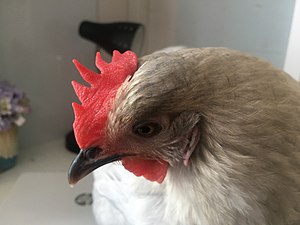
Roosters tin usually be differentiated from hens by their striking plumage of long flowing tails and shiny, pointed feathers on their necks ('hackles') and backs ('saddle'), which are typically of brighter, bolder colours than those of females of the aforementioned breed. However, in some breeds, such as the Sebright chicken, the rooster has just slightly pointed neck feathers, the aforementioned colour as the hen's. The identification tin can be made by looking at the comb, or eventually from the development of spurs on the male person'southward legs (in a few breeds and in certain hybrids, the male and female chicks may be differentiated by colour). Adult chickens have a fleshy crest on their heads called a comb, or cockscomb, and hanging flaps of skin either side under their beaks called wattles. Collectively, these and other fleshy protuberances on the head and pharynx are chosen caruncles. Both the developed male and female have wattles and combs, but in most breeds these are more prominent in males. A 'muff' or 'beard' is a mutation found in several chicken breeds which causes extra feathering under the chicken's face, giving the advent of a beard.[32]
Domestic chickens are not capable of long-distance flight, although lighter chickens are by and large capable of flying for short distances, such equally over fences or into trees (where they would naturally roost). Chickens may occasionally fly briefly to explore their environment, merely generally exercise so only to abscond perceived danger.
Behavior
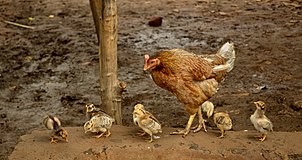

Hen with chicks, Portugal
Chickens are gregarious birds and live together in flocks. They have a communal arroyo to the incubation of eggs and raising of immature. Individual chickens in a flock will dominate others, establishing a "pecking society", with dominant individuals having priority for nutrient admission and nesting locations. Removing hens or roosters from a flock causes a temporary disruption to this social lodge until a new pecking social club is established. Adding hens, especially younger birds, to an existing flock can lead to fighting and injury.[33]
When a rooster finds food, he may phone call other chickens to eat first. He does this past clucking in a loftier pitch likewise as picking upwards and dropping the food. This behaviour may also be observed in female parent hens to call their chicks and encourage them to eat.
A rooster'south crowing is a loud and sometimes shrill call and sends a territorial signal to other roosters.[34] Nevertheless, roosters may too crow in response to sudden disturbances inside their surroundings. Hens cluck loudly afterward laying an egg, and also to phone call their chicks. Chickens besides requite different warning calls when they sense a predator approaching from the air or on the ground.[35]
Crowing
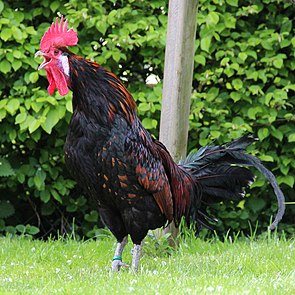
Roosters almost always start exultation before four months of historic period. Although it is possible for a hen to crow also, exultation (together with hackles development) is one of the clearest signs of beingness a rooster.[36]
Rooster crowing contests
Rooster crowing contests, besides known as crowing contests, are a traditional sport in several countries, such as Frg, the netherlands, Belgium,[37] the United States, Republic of indonesia and Japan. The oldest contests are held with longcrowers. Depending on the breed, either the duration of the exultation or the times the rooster crows inside a certain fourth dimension is measured.
Courting
To initiate courting, some roosters may trip the light fantastic in a circumvolve around or well-nigh a hen ("a circumvolve dance"), often lowering the wing which is closest to the hen.[38] The dance triggers a response in the hen[38] and when she responds to his "call," the rooster may mountain the hen and proceed with the mating.
More specifically, mating typically involves the following sequence:
- Male approaching the hen
- Male pre-copulatory waltzing
- Male person waltzing
- Female crouching (receptive posture) or stepping bated or running away (if unwilling to copulate)
- Male mounting
- Male treading with both feet on hen'south dorsum
- Male tail angle (post-obit successful copulation)[39]
Nesting and laying behaviour

Craven eggs vary in colour depending on the breed, and sometimes, the hen, typically ranging from brilliant white to shades of chocolate-brown and fifty-fifty blue, green, light pinkish and recently reported purple (found in Southward Asia) (Araucana varieties).

Chicks before their first outing
Hens will frequently attempt to lay in nests that already contain eggs and have been known to movement eggs from neighbouring nests into their ain. The outcome of this behaviour is that a flock will use only a few preferred locations, rather than having a different nest for every bird. Hens will often express a preference to lay in the same location. It is not unknown for 2 (or more) hens to effort to share the same nest at the aforementioned time. If the nest is small, or one of the hens is particularly adamant, this may effect in chickens trying to lay on top of each other. There is bear witness that individual hens prefer to be either solitary or gregarious nesters.[forty]

A chick sitting in a person's hand
Broodiness
Under natural conditions, most birds lay only until a clutch is complete, and they will then incubate all the eggs. Hens are then said to "go broody". The broody hen volition stop laying and instead will focus on the incubation of the eggs (a total clutch is usually almost 12 eggs). She volition "sit" or "set" on the nest, fluff up or pecking in defense if disturbed or removed. The hen volition rarely leave the nest to swallow, drink, or grit-breast-stroke.[41] While brooding, the hen maintains the nest at a constant temperature and humidity, every bit well as turning the eggs regularly during the offset part of the incubation. To stimulate broodiness, owners may identify several artificial eggs in the nest. To discourage it, they may identify the hen in an elevated cage with an open up wire flooring.

Skull of a three-calendar week-old chicken. Here the opisthotic bone appears in the occipital region, as in the adult Chelonian. bo = Basi-occipital, bt = Basi-temporal, eo = Opisthotic, f = Frontal, fm = Foramen magnum, fo = Fontanella, oc = Occipital condyle, op = Opisthotic, p = Parietal, pf = Post-frontal, sc = Sinus canal in supra-occipital, so = Supra-occpital, sq = Squamosal, 8 = Leave of vagus nerve.
Breeds artificially adult for egg production rarely get broody, and those that do ofttimes stop part-style through the incubation. Even so, other breeds, such as the Cochin, Cornish and Silkie, exercise regularly go broody, and make excellent mothers, not only for chicken eggs just also for those of other species — even those with much smaller or larger eggs and different incubation periods, such as quail, pheasants, ducks, turkeys, or geese.
Hatching and early life
Fertile chicken eggs hatch at the terminate of the incubation period, almost 21 days.[38] Development of the chick starts merely when incubation begins, so all chicks hatch within a day or ii of each other, despite perhaps existence laid over a period of 2 weeks or and so. Before hatching, the hen tin hear the chicks peeping inside the eggs, and will gently cluck to stimulate them to interruption out of their shells. The chick begins by "pipping"; pecking a breathing hole with its egg molar towards the edgeless end of the egg, normally on the upper side. The chick and so rests for some hours, arresting the remaining egg yolk and withdrawing the claret supply from the membrane beneath the shell (used earlier for breathing through the crush). The chick and so enlarges the hole, gradually turning round as it goes, and somewhen severing the edgeless finish of the shell completely to make a lid. The chick crawls out of the remaining shell, and the wet downward dries out in the warmth of the nest.
Hens usually remain on the nest for about 2 days after the first chick hatches, and during this time the newly hatched chicks feed by absorbing the internal yolk sac. Some breeds sometimes kickoff eating cracked eggs, which tin can become habitual.[42] Hens fiercely baby-sit their chicks, and breed them when necessary to go along them warm, at first often returning to the nest at night. She leads them to food and water and will phone call them toward edible items, simply seldom feeds them directly. She continues to treat them until they are several weeks old.
Defensive behaviour
Chickens may occasionally gang up on a weak or inexperienced predator. At least one apparent report exists of a young fob killed by hens.[43] [44] [45] A group of hens have been recorded in attacking a hawk that had entered their coop.[46]
If a craven is threatened past predators, stress, or is sick, there is a chance that they volition puff up their feathers.[41]
Reproduction
Sperm transfer occurs past cloacal contact between the male person and female, in a maneuver known every bit the "cloacal kiss".[47] Every bit with birds in general, reproduction is controlled by a neuroendocrine arrangement, the Gonadotropin-Releasing Hormone-I neurons in the hypothalamus. Locally to the reproductive organisation itself, reproductive hormones such as estrogen, progesterone, gonadotropins (luteinizing hormone and follicle-stimulating hormone) initiate and maintain sexual maturation changes. Over fourth dimension there is reproductive refuse, thought to be due to GnRH-I-N refuse. Because there is significant inter-individual variability in egg-producing duration, it is believed to be possible to breed for further extended useful lifetime in egg-layers.[48]
Embryology
(Video) Primeval gestation stages and blood circulation of a chicken embryo
Chicken embryos accept long been used as model systems to report developing embryos. Big numbers of embryos can be provided by commercial craven farmers who sell fertilized eggs which can be hands opened and used to observe the developing embryo. Equally important, embryologists can carry out experiments on such embryos, close the egg once again and report the event later on. For example, many of import discoveries in the area of limb development have been made using chicken embryos, such as the discovery of the apical ectodermal ridge (AER) and the zone of polarizing activeness (ZPA) by John W. Saunders.[49]
In 2006, scientists researching the ancestry of birds "turned on" a chicken recessive gene, talpid2, and constitute that the embryo jaws initiated germination of teeth, similar those establish in aboriginal bird fossils. John Fallon, the overseer of the project, stated that chickens have "...retained the power to make teeth, under sure conditions... ."[l]

The Chiliad. gallus genome has 39 pairs of chromosomes, whereas the human genome contains 23 pairs
Genetics and genomics
Given its eminent office in farming, meat product, but also research, the house chicken was the start bird genome to exist sequenced.[51] At i.21 Gb, the chicken genome is considerably smaller than other vertebrate genomes, such as the man genome (3 Gb). The concluding gene prepare contained 26,640 genes (including noncoding genes and pseudogenes), with a full of 19,119 protein-coding genes in annotation release 103 (2017), a like number of protein-coding genes as in the man genome.[52]
Physiology
Populations of chickens from high altitude regions like Tibet take special physiological adaptations that upshot in a higher hatching charge per unit in low oxygen environments. When eggs are placed in a hypoxic environment, chicken embryos from these populations express much more than hemoglobin than embryos from other craven populations. This hemoglobin also has a greater affinity for oxygen, assuasive hemoglobin to bind to oxygen more readily.[53] [54]
Pinopsins were originally discovered in the chicken pineal gland.[55]
Immunology
Although all avians appear to have lost TLR9, artificial amnesty confronting bacterial pathogens has been induced in neonatal chicks by Taghavi et al 2008 using tailored oligodeoxynucleotides.[56]
Breeding
Origins
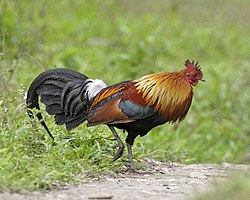
Galliformes, the order of bird that chickens belong to, is directly linked to the survival of birds when all other dinosaurs went extinct. H2o or ground-dwelling fowl, similar to mod partridges, survived the Cretaceous–Paleogene extinction result that killed all tree-dwelling birds and dinosaurs.[57] Some of these evolved into the mod galliformes, of which domesticated chickens are a primary model. They are descended primarily from the red junglefowl (Gallus gallus) and are scientifically classified as the aforementioned species.[58] As such, domesticated chickens can and practise freely interbreed with populations of reddish junglefowl.[58] Subsequent hybridization of the domestic chicken with grey junglefowl, Sri Lankan junglefowl and greenish junglefowl occurred;[59] a gene for yellow skin, for instance, was incorporated into domestic birds through hybridization with the gray junglefowl (G. sonneratii).[threescore] In a report published in 2020, it was found that chickens shared between 71% - 79% of their genome with cherry junglefowl, with the period of domestication dated to 8,000 years ago.[59]

Red junglefowl hen in India
The traditional view is that chickens were first domesticated for cockfighting in Asia, Africa, and Europe.[two] In the final decade, in that location have been a number of genetic studies to analyze the origins. According to 1 early study, a single domestication event of the ruby junglefowl in what now is the state of Thailand gave ascension to the modern craven with modest transitions separating the modern breeds.[61] The red junglefowl, known as the bamboo fowl in many Southeast Asian languages, is well adapted to take reward of the vast quantities of seed produced during the end of the multi-decade bamboo seeding wheel, to heave its own reproduction.[62] In domesticating the chicken, humans took advantage of this predisposition for prolific reproduction of the red junglefowl when exposed to large amounts of nutrient.[63]
Exactly when and where the craven was domesticated remains a controversial issue. Genomic studies estimate that the chicken was domesticated 8,000 years ago[59] in Southeast Asia and spread to Communist china and India 2000–3000 years later. Archaeological evidence supports domestic chickens in Southeast Asia well before 6000 BC, China by 6000 BC and Republic of india by 2000 BC.[59] [64] [65] A landmark 2020 Nature study that fully sequenced 863 chickens across the world suggests that all domestic chickens originate from a single domestication event of red junglefowl whose present-twenty-four hours distribution is predominantly in southwestern China, northern Thailand and Myanmar. These domesticated chickens spread across Southeast and South asia where they interbred with local wild species of junglefowl, forming genetically and geographically distinct groups. Analysis of the most pop commercial breed shows that the White Leghorn breed possesses a mosaic of divergent ancestries inherited from subspecies of red junglefowl.[66] [67] [68]
Middle Eastern chicken remains go back to a little earlier than 2000 BC in Syrian arab republic; chickens went southward only in the 1st millennium BC. They reached Arab republic of egypt for purposes of cockfighting most 1400 BC, and became widely bred but in Ptolemaic Egypt (near 300 BC).[69] Phoenicians spread chickens along the Mediterranean coasts every bit far as Iberia. During the Hellenistic menstruation (fourth–2nd centuries BC), in the Southern Levant, chickens began to be widely domesticated for food.[iii] This change occurred at least 100 years before domestication of chickens spread to Europe.
Chickens reached Europe circa 800 BC.[70] Breeding increased under the Roman Empire, and was reduced in the Middle Ages.[69] Genetic sequencing of craven bones from archaeological sites in Europe revealed that in the High Heart Ages chickens became less ambitious and began to lay eggs earlier in the convenance flavour.[71]
3 possible routes of introduction into Africa around the early kickoff millennium Ad could have been through the Egyptian Nile Valley, the Due east Africa Roman-Greek or Indian trade, or from Carthage and the Berbers, across the Sahara. The earliest known remains are from Mali, Nubia, Eastward Declension, and Due south Africa and date dorsum to the middle of the first millennium Advert.[69]
Domestic chicken in the Americas before Western contact is yet an ongoing word, just blueish-egged chickens, found only in the Americas and Asia, advise an Asian origin for early American chickens.[69]
A lack of data from Thailand, Russia, the Indian subcontinent, Southeast Asia and Sub-Saharan Africa makes it difficult to lay out a clear map of the spread of chickens in these areas; better description and genetic analysis of local breeds threatened by extinction may also help with research into this area.[69]
South America
An unusual multifariousness of chicken that has its origins in South America is the Araucana, bred in southern Chile past the Mapuche people. Araucanas lay blue-green eggs. Additionally, some Araucanas are tailless, and some have tufts of feathers effectually their ears. It has long been suggested that they pre-date the arrival of European chickens brought by the Spanish and are evidence of pre-Columbian trans-Pacific contacts between Asian or Pacific Oceanic peoples, peculiarly the Polynesians, and South America. In 2007, an international squad of researchers reported the results of their analysis of craven bones found on the Arauco Peninsula in south-central Chile. Radiocarbon dating suggested that the chickens were pre-Columbian, and Deoxyribonucleic acid analysis showed that they were related to prehistoric populations of chickens in Polynesia.[72] These results appeared to confirm that the chickens came from Polynesia and that there were transpacific contacts between Polynesia and Southward America before Columbus'south arrival in the Americas.[73] [74]
However, a later report looking at the same specimens concluded:
A published, apparently pre-Columbian, Chilean specimen and half dozen pre-European Polynesian specimens as well cluster with the same European/Indian subcontinental/Southeast Asian sequences, providing no support for a Polynesian introduction of chickens to South America. In contrast, sequences from two archaeological sites on Easter Island group with an uncommon haplogroup from Republic of indonesia, Nippon, and People's republic of china and may correspond a genetic signature of an early Polynesian dispersal. Modeling of the potential marine carbon contribution to the Chilean archaeological specimen casts further doubt on claims for pre-Columbian chickens, and definitive proof volition require farther analyses of aboriginal Deoxyribonucleic acid sequences and radiocarbon and stable isotope data from archaeological excavations inside both Chile and Polynesia.[75]
The fence for and confronting a Polynesian origin for South American chickens continued with this 2014 paper and subsequent responses in PNAS.[76]
Utilise past humans
Farming

A former bombardment hen, five days after release. Notation the pale comb – the comb may be an indicator of health or vigor.[77]
More than 50 billion chickens are reared annually as a source of meat and eggs.[78] In the U.s.a. alone, more than than 8 billion chickens are slaughtered each twelvemonth for meat,[79] and more than 300 meg chickens are reared for egg production.[80]
The vast bulk of poultry are raised in manufacturing plant farms. According to the Worldwatch Institute, 74 percent of the world's poultry meat and 68 percent of eggs are produced this manner.[81] An alternative to intensive poultry farming is free-range farming.
Friction between these 2 main methods has led to long-term issues of ethical consumerism. Opponents of intensive farming argue that information technology harms the environs, creates human being wellness risks and is inhumane.[82] Advocates of intensive farming say that their highly efficient systems salvage country and food resources owing to increased productivity, and that the animals are looked after in state-of-the-fine art environmentally controlled facilities.[83]
Reared for meat

A commercial chicken business firm with open up sides raising broiler pullets for meat
Chickens farmed for meat are chosen broilers. Chickens will naturally live for six or more years, but broiler breeds typically accept less than vi weeks to reach slaughter size.[84] A costless range or organic broiler will usually be slaughtered at almost 14 weeks of age.
Reared for eggs
Chickens farmed primarily for eggs are chosen layer hens. In total, the Britain solitary consumes more than 34 one thousand thousand eggs per day.[85] Some hen breeds tin produce over 300 eggs per twelvemonth, with "the highest authenticated rate of egg laying being 371 eggs in 364 days".[86] After 12 months of laying, the commercial hen's egg-laying power starts to decline to the point where the flock is commercially unviable. Hens, particularly from battery cage systems, are sometimes infirm or have lost a significant amount of their feathers, and their life expectancy has been reduced from effectually seven years to less than two years.[87] In the U.k. and Europe, laying hens are so slaughtered and used in processed foods or sold as "soup hens".[87] In some other countries, flocks are sometimes forcefulness moulted, rather than being slaughtered, to re-invigorate egg-laying. This involves complete withdrawal of food (and sometimes water) for vii–14 days[88] or sufficiently long to cause a trunk weight loss of 25 to 35%,[89] or up to 28 days nether experimental conditions.[90] This stimulates the hen to lose her feathers, merely too re-invigorates egg-production. Some flocks may be force-moulted several times. In 2003, more than 75% of all flocks were moulted in the US.[91]
As pets

A 95-year-old woman from Havana, Cuba, with her pet rooster
Keeping chickens as pets became increasingly popular in the 2000s[92] among urban and suburban residents.[93] Many people obtain chickens for their egg production merely often proper name them and treat them equally any other pet like cats or dogs. Chickens provide companionship and have private personalities. While many do not cuddle much, they will eat from ane'due south hand, jump onto one'southward lap, respond to and follow their handlers, as well every bit show amore.[94] [95]
Chickens are social, inquisitive, intelligent[96] birds, and many find their behaviour entertaining.[97] Certain breeds, such equally Silkies and many bantam varieties, are generally docile and are often recommended every bit good pets around children with disabilities.[98] Many people feed chickens in part with kitchen food scraps.

Backyard heritage chickens eating kitchen food scraps.
Cockfighting

A cockfight is a contest held in a ring called a cockpit betwixt two cocks known as gamecocks. This term, denoting a erect kept for game, sport, pastime or amusement, appears in 1646,[99] after "erect of the game" used by George Wilson in the earliest known book on the secular sport, The Commendation of Cocks and Cock Fighting of 1607. Gamecocks are non typical farm chickens. The cocks are specially bred and trained for increased stamina and force. The comb and wattle are removed from a young gamecock considering, if left intact, they would be a disadvantage during a match. This procedure is called dubbing. Sometimes the cocks are given drugs to increment their stamina or thicken their blood, which increases their chances of winning. Cockfighting is considered a traditional sporting consequence by some, and an example of animal cruelty past others and is therefore outlawed in most countries.[100] Usually wagers are fabricated on the upshot of the match, with the survivor or last bird standing declared winner.
Chickens were originally used for cockfighting, a sport where 2 male chickens or "cocks" fight each other until one dies or becomes badly injured. Cocks possess congenital aggression toward all other cocks to contest with females. Studies suggest that cockfights have existed fifty-fifty up to the Indus Valley Civilization as a pastime.[101] Today it is commonly associated with religious worship, pastime, and gambling in Asian and some Southward American countries. While not all fights are to the death, about utilise metallic spurs every bit a "weapon" attached above or below the craven's ain spur and with this typically results in expiry in 1 or both cocks. If chickens are in practise owners identify gloves on the spurs to prevent injuries. Cockfighting has been banned in most western countries and debated by animal rights activist for its brutality.
Bogus incubation

Incubation can successfully occur artificially in machines that provide the correct, controlled surroundings for the developing chick.[102] [103] The average incubation period for chickens is 21 days but may depend on the temperature and humidity in the incubator. Temperature regulation is the most critical cistron for a successful hatch. Variations of more than one °C (1.viii °F) from the optimum temperature of 37.v °C (99.5 °F) volition reduce hatch rates. Humidity is likewise important because the rate at which eggs lose water by evaporation depends on the ambience relative humidity. Evaporation tin be assessed past candling, to view the size of the air sac, or by measuring weight loss. Relative humidity should be increased to around 70% in the last three days of incubation to keep the membrane around the hatching chick from drying out afterward the chick cracks the shell. Lower humidity is usual in the first 18 days to ensure adequate evaporation. The position of the eggs in the incubator can also influence hatch rates. For best results, eggs should be placed with the pointed ends downward and turned regularly (at to the lowest degree three times per 24-hour interval) until ane to iii days earlier hatching. If the eggs aren't turned, the embryo inside may stick to the vanquish and may hatch with physical defects. Adequate ventilation is necessary to provide the embryo with oxygen. Older eggs crave increased ventilation.
Many commercial incubators are industrial-sized with shelves holding tens of thousands of eggs at a fourth dimension, with rotation of the eggs a fully automated process. Abode incubators are boxes holding from 6 to 75 eggs; they are usually electrically powered, but in the past some were heated with an oil or paraffin lamp.
Diseases and ailments
Chickens are susceptible to several parasites, including lice, mites, ticks, fleas, and intestinal worms, equally well as other diseases. Despite the name, they are not affected by chickenpox, which is generally restricted to humans.[104]
Chickens tin can behave and transmit salmonella in their dander and carrion. In the United states of america, the Centers for Illness Control and Prevention advise against bringing them indoors or letting small children handle them.[105] [106]
Some of the diseases that can affect chickens are shown below:
| Name | Common name | Cause |
|---|---|---|
| Aspergillosis | Aspergillus fungi | |
| Avian influenza | bird flu | virus |
| Histomoniasis | blackhead disease | Histomonas meleagridis |
| Botulism | paralysis | Clostridium botulinum toxin |
| Muzzle layer fatigue | mineral deficiency, lack of concrete exercise | |
| Campylobacteriosis | tissue injury in the gut | |
| Coccidiosis | Coccidia | |
| Colds | virus | |
| Ingather jump Archived 2010-ten-26 at the Wayback Machine | improper feeding | |
| Dermanyssus gallinae | cherry mite | parasite |
| Egg binding | oversized egg | |
| Erysipelas | Streptococcus bacteria | |
| Fatty liver hemorrhagic syndrome | high-energy food | |
| Fowl cholera | Pasteurella multocida | |
| Fowlpox | Fowlpox virus | |
| Fowl typhoid | bacteria | |
| Avian infectious laryngotracheitis | LT | Gallid alphaherpesvirus 1 |
| Gapeworm | Syngamus trachea | worms |
| Infectious bronchitis | Infectious bronchitis virus | |
| Infectious bursal disease | Gumboro | infectious bursal affliction virus |
| Infectious coryza in chickens | Avibacterium paragallinarum | |
| Lymphoid leukosis | Avian sarcoma leukosis virus | |
| Marek'southward disease | Gallid alphaherpesvirus 2 | |
| Moniliasis | yeast infection or thrush | Candida fungi |
| Mycoplasma | leaner | |
| Newcastle disease | Avian avulavirus 1 | |
| Necrotic enteritis Archived 2010-12-16 at the Wayback Machine | bacteria | |
| Omphalitis | Mushy chick affliction[107] | bacteria |
| Peritonitis[108] | infection in abdomen from egg yolk | |
| Psittacosis | Chlamydia psittaci | |
| Pullorum | Salmonella | bacteria |
| Scaly leg | Knemidokoptes mutans | |
| Squamous cell carcinoma | cancer | |
| Tibial dyschondroplasia | speed growing | |
| Toxoplasmosis | Toxoplasma gondii | |
| Ulcerative enteritis | bacteria | |
| Ulcerative pododermatitis | bumblefoot | leaner |
History

An early domestication of chickens in Southeast Asia is probable, since the word for domestic chicken (*manuk) is part of the reconstructed Proto-Austronesian language . Chickens, together with dogs and pigs, were the domestic animals of the Lapita culture,[109] the first Neolithic civilisation of Oceania.[110]
The first pictures of chickens in Europe are found on Corinthian pottery of the 7th century BC.[111] [112]
Chickens were spread past Polynesian seafarers and reached Easter Island in the twelfth century AD, where they were the only domestic beast, with the possible exception of the Polynesian rat (Rattus exulans). They were housed in extremely solid craven coops built from rock, which was start reported every bit such to Linton Palmer in 1868, who also "expressed his doubts about this".[113]
In culture

Abraxas seen with a craven's head
The mythological basilisk or cockatrice is depicted as a reptile-like animate being with the upper body of a rooster.[114] [115] Abraxas, a effigy in Gnosticism, is portrayed in a similar fashion as well.[116]
Gallery
-

Rooster in the coat of arms of Laitila
-

-

-
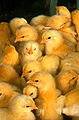
A group of chicks
See also
- Abnormal behaviour of birds in captivity
- Battery Hen Welfare Trust, a UK charity for laying hens
- Craven as food
- Chicken eyeglasses
- Chicken fat
- Chicken hypnotism
- Craven or the egg
- Chicken manure
- Chook raffle – a type of raffle where the prize is a chicken.
- Early feeding
- Feral craven
- Gamebird hybrids – hybrids betwixt chickens, peafowl, guineafowl and pheasants
- Henopause
- Hen and chicks, a type of plant
- Listing of chicken breeds
- Poularde
- Rubber chicken
- Sex change in chickens
- Symbolic chickens
- "Tastes like chicken"
- Unihemispheric slow-wave sleep
- Urban craven keeping
- "Why did the craven cantankerous the road?"
Roosters
- Chicken laugh
- Cock egg
- Red Junglefowl
- Rooster Flag (disambiguation)
- Rooster of Barcelos
Explanatory notes
- ^ The surgical and chemical castration of chickens is at present illegal in some parts of the world
References
- ^ "the brute of nations". sciencedirect . Retrieved three Feb 2022.
- ^ a b "The Ancient City Where People Decided to Eat Chickens". NPR. Archived from the original on May 16, 2018. Retrieved May fifteen, 2018.
- ^ a b Perry-Gal, Lee; Erlich, Adi; Gilboa, Ayelet; Bar-Oz, Guy (11 Baronial 2015). "Earliest economical exploitation of chicken outside East asia: Evidence from the Hellenistic Southern Levant". Proceedings of the National Academy of Sciences. 112 (32): 9849–9854. Bibcode:2015PNAS..112.9849P. doi:10.1073/pnas.1504236112. PMC4538678. PMID 26195775.
- ^ "Number of chickens worldwide from 1990 to 2018". Statista . Retrieved February 23, 2020.
- ^ a b UN'southward Food and Agriculture Organization (July 2011). "Global Livestock Counts". The Economist. Archived from the original on July 15, 2016. Retrieved July thirteen, 2017.
- ^ Xiang, Hai; Gao, Jianqiang; Yu, Baoquan; Zhou, Hui; Cai, Dawei; Zhang, Youwen; Chen, Xiaoyong; Wang, Xi; Hofreiter, Michael; Zhao, Xingbo (9 December 2014). "Early Holocene craven domestication in northern China". Proceedings of the National Academy of Sciences. 111 (49): 17564–17569. Bibcode:2014PNAS..11117564X. doi:10.1073/pnas.1411882111. PMC4267363. PMID 25422439.
- ^ Maguelonne Toussaint-Samat, (Anthea Bell, translator) The History of Food, Ch. 11 "The History of Poultry", revised ed. 2009, p. 306.
- ^ Carter, Howard (April 1923). "An Ostracon Depicting a Red Jungle-Fowl (The Earliest Known Drawing of the Domestic Cock)". The Periodical of Egyptian Archaeology. 9 (1/ii): 1–4. doi:ten.2307/3853489. JSTOR 3853489.
- ^ Pritchard, Earl H. "The Asiatic Campaigns of Thutmose III". Ancient Nigh East Texts related to the Old Testament. p. 240.
- ^ Roehrig, Catharine H.; Dreyfus, Renée; Keller, Cathleen A. (2005). Hatshepsut: From Queen to Pharaoh. New York: Metropolitan Museum of Art. p. 268. ISBN978-1-58839-173-five . Retrieved November 26, 2015.
- ^ "Cock". Cambridge Dictionary. Archived from the original on 2015-09-07. Retrieved 4 March 2021.
- ^ "Hen". Cambridge Dictionary. Archived from the original on 2015-09-07. Retrieved 4 March 2021.
- ^ "Definition of biddy | Dictionary.com". www.dictionary.com.
- ^ "Biddy definition and meaning | Collins English Dictionary". www.collinsdictionary.com.
- ^ "Chick". Cambridge Dictionary. Archived from the original on 2015-09-07.
- ^ "Chook". Cambridge Dictionary. Archived from the original on 2015-09-07. Retrieved four March 2021.
- ^ Cockerel. Dictionary.reference.com. Archived from the original on March 7, 2016. Retrieved August 29, 2010.
- ^ Pullet. Dictionary.reference.com. Archived from the original on November ix, 2010. Retrieved August 29, 2010.
- ^ "Overview of the Poultry Industry" (PDF). Overview of the Poultry Industry. Missouri Department of Elementary and Secondary Education. p. viii. Archived (PDF) from the original on 2020-10-23.
- ^ Berhardt, Clyde East. B. (1986). I Remember: Eighty Years of Black Entertainment, Large Bands. Philadelphia: University of Pennsylvania Press. p. 153. ISBN978-0-8122-8018-0. OCLC 12805260.
- ^ Dohner, Janet Vorwald (January 1, 2001). The Encyclopedia of Celebrated and Endangered Livestock and Poultry Breeds. Yale University Press. ISBN978-0300138139. Archived from the original on June 28, 2016. Retrieved Feb fourteen, 2016.
- ^ "Chicken". Merriam Webster Dictionary. Archived from the original on 2008-08-21. Retrieved 4 March 2021.
- ^ "Definition of ROOSTER". www.merriam-webster.com.
- ^ Hugh Rawson "Why Practice We Say...? Rooster", American Heritage, Aug./Sept. 2006.
- ^ Online Etymology Dictionary Entry for rooster (n.), May 2019
- ^ "Definition of ROOST". Collins English Lexicon. Retrieved 16 October 2021.
- ^ "Info on Chicken Care". Ideas-4-pets.co.united kingdom of great britain and northern ireland. 2003. Archived from the original on June 25, 2015. Retrieved August 13, 2008.
- ^ D Lines (July 27, 2013). "Chicken Kills Rattlesnake". YouTube. Archived from the original on 2021-12-eleven. Retrieved March 13, 2019.
- ^ Gerard P.Worrell AKA "Farmer Jerry". "Frequently asked questions near chickens & eggs". Gworrell.freeyellow.com. Archived from the original on September 16, 2008. Retrieved Baronial 13, 2008.
- ^ "The Poultry Guide – A to Z and FAQs". Ruleworks.co.britain. Archived from the original on November 28, 2010. Retrieved Baronial 29, 2010.
- ^ Smith, Jamon (August six, 2006). "Earth's oldest chicken starred in magic shows, was on 'This night Bear witness'". Tuscaloosa News. Alabama, USA. Archived from the original on Feb twenty, 2019. Retrieved May 18, 2020.
- ^ Ying Guo, Xiaorong Gu, Zheya Sheng, Yanqiang Wang, Chenglong Luo, Ranran Liu, Hao Qu, Dingming Shu, Jie Wen, Richard P. M. A. Crooijmans, Örjan Carlborg, Yiqiang Zhao, Xiaoxiang Hu, Ning Li (2016). A Complex Structural Variation on Chromosome 27 Leads to the Ectopic Expression of HOXB8 and the Muffs and Beard Phenotype in Chickens. PLoS Genetics. 12 (6): e1006071. doi:10.1371/journal.pgen.1006071.
- ^ "Introducing new hens to a flock " Musings from a Stonehead". Stonehead.wordpress.com. Archived from the original on August 13, 2010. Retrieved August 29, 2010.
- ^ "Top cock: Roosters crow in pecking order". Archived from the original on January xv, 2018. Retrieved January 14, 2018.
- ^ Evans, Christopher Due south.; Evans, Linda; Marler, Peter (July 1993). "On the meaning of warning calls: functional reference in an avian vocal organization". Beast Behaviour. 46 (1): 23–38. doi:ten.1006/anbe.1993.1158. S2CID53165305.
- ^ Read, Gina (5 July 2008). "Sexing Chickens". Keeping Chickens Newsletter. keepingchickensnewsletter.com. Retrieved 5 July 2008.
- ^ Cock crowing competition recognised as National Heritage in Belgium Stefaan De Groote, Het Nieuwsblad, 27. June 2011 (in Dutch). Accessed October 2015
- ^ a b c Grandin, Temple; Johnson, Catherine (2005). Animals in Translation . New York City: Scribner. pp. 69–71. ISBN978-0-7432-4769-6.
- ^ Cheng, Kimberly M.; Burns, Jeffrey T. (August 1988). "Dominance Relationship and Mating Behavior of Domestic Cocks: A Model to Study Mate-Guarding and Sperm Competition in Birds". The Condor. xc (3): 697–704. doi:10.2307/1368360. JSTOR 1368360.
- ^ Sherwin, C.Chiliad.; Nicol, C.J. (1993). "Factors influencing floor-laying by hens in modified cages". Practical Animal Behaviour Science. 36 (2–3): 211–222. doi:x.1016/0168-1591(93)90011-d.
- ^ a b "Why Practice Chickens Puff up Their Feathers? I iv Reasons Explained". Retrieved June 16, 2021.
- ^ Ali, A.; Cheng, K.M. (1985). "Early on egg production in genetically blind (rc/rc) chickens in comparison with sighted (Rc+/rc) controls". Poultry Science. 64 (5): 789–794. doi:x.3382/ps.0640789. PMID 4001066.
- ^ "Chickens team up to 'peck fox to death'". The Independent. March 13, 2019. Archived from the original on March 15, 2019. Retrieved March 13, 2019.
- ^ "Chickens 'gang up' to kill fox". Bbc.co.u.k.. March 13, 2019. Archived from the original on March 14, 2019. Retrieved March 13, 2019.
- ^ AFP (March 12, 2019). "Chickens 'teamed up to kill fox' at Brittany farming schoolhouse". Theguardian.com. Archived from the original on March 13, 2019. Retrieved March 13, 2019.
- ^ "Check this out! This hawk thought he'd have a chicken dinner until he met our hens". Rustic Road Subcontract – via Facebook.
- ^ Briskie, J. V.; R. Montgomerie (1997). "Sexual Choice and the Intromittent Organ of Birds". Journal of Avian Biology. 28 (i): 73–86. doi:10.2307/3677097. JSTOR 3677097.
- ^ Bain, M. M.; Nys, Y.; Dunn, I.C. (2016-05-03). "Increasing persistency in lay and stabilising egg quality in longer laying cycles. What are the challenges?". British Poultry Scientific discipline. Taylor & Francis. 57 (three): 330–338. doi:10.1080/00071668.2016.1161727. ISSN 0007-1668. PMC4940894. PMID 26982003. S2CID 17842329.
- ^ Young, John J.; Tabin, Clifford J. (September 2017). "Saunders'due south framework for understanding limb development every bit a platform for investigating limb evolution". Developmental Biological science. 429 (two): 401–408. doi:10.1016/j.ydbio.2016.11.005. PMC5426996. PMID 27840200.
- ^ Scientists Find Chickens Retain Ancient Power to Grow Teeth Archived June 20, 2008, at the Wayback Machine Ammu Kannampilly, ABC News, February 27, 2006. Retrieved October i, 2007.
- ^ International Craven Genome Sequencing Consortium (9 December 2004). "Sequence and comparative analysis of the chicken genome provide unique perspectives on vertebrate development". Nature. 432 (7018): 695–716. Bibcode:2004Natur.432..695C. doi:x.1038/nature03154. PMID 15592404.
- ^ Warren, Wesley C.; Hillier, LaDeana W.; Tomlinson, Republic of chad; Minx, Patrick; Kremitzki, Milinn; Graves, Tina; Markovic, Chris; Bouk, Nathan; Pruitt, Kim D.; Thibaud-Nissen, Francoise; Schneider, Valerie; Mansour, Tamer A.; Brown, C. Titus; Zimin, Aleksey; Hawken, Rachel; Abrahamsen, Mitch; Pyrkosz, Alexis B.; Morisson, Mireille; Fillon, Valerie; Vignal, Alain; Chow, William; Howe, Kerstin; Fulton, Janet Due east.; Miller, Marcia M.; Lovell, Peter; Mello, Claudio V.; Wirthlin, Morgan; Mason, Andrew S.; Kuo, Richard; Burt, David W.; Dodgson, Jerry B.; Cheng, Hans H. (January 2017). "A New Craven Genome Assembly Provides Insight into Avian Genome Structure". G3. 7 (1): 109–117. doi:x.1534/g3.116.035923. PMC5217101. PMID 27852011.
- ^ Gou, Xiao; Li, Ning; Lian, Linsheng; Yan, Dawei; Zhang, Hao; Wei, Zhehui; Wu, Changxin (June 2007). "Hypoxic adaptations of hemoglobin in Tibetan chick embryo: High oxygen-affinity mutation and selective expression". Comparative Biochemistry and Physiology Part B: Biochemistry and Molecular Biology. 147 (ii): 147–155. doi:10.1016/j.cbpb.2006.11.031. PMID 17360214.
- ^ Zhang, H.; Wang, X.T.; Chamba, Y.; Ling, Y.; Wu, C.X. (October 2008). "Influences of Hypoxia on Hatching Performance in Chickens with Dissimilar Genetic Adaptation to High Altitude". Poultry Science. 87 (10): 2112–2116. doi:10.3382/ps.2008-00122. ISSN 0032-5791. PMID 18809874.
- ^ Nakane, Yusuke; Yoshimura, Takashi (2019-02-xv). "Photoperiodic Regulation of Reproduction in Vertebrates". Annual Review of Animal Biosciences. Annual Reviews. 7 (1): 173–194. doi:10.1146/annurev-creature-020518-115216. ISSN 2165-8102. PMID 30332291. S2CID 52984435.
- ^ Brownlie, Robert; Allan, Brenda (2010-09-01). "Avian cost-like receptors". Prison cell and Tissue Inquiry. Springer. 343 (1): 121–130. doi:10.1007/s00441-010-1026-0. ISSN 0302-766X. PMID 20809414. S2CID 2877905.
- ^ Pennisi, Elizabeth (24 May 2018). "Quaillike creatures were the only birds to survive the dinosaur-killing asteroid touch on". Science. doi:x.1126/science.aau2802.
- ^ a b Wong, Chiliad. M.; Liu, B.; Wang, J.; Zhang, Y.; Yang, X.; Zhang, Z.; Meng, Q.; Zhou, J.; Li, D.; Zhang, J.; Ni, P.; Li, Due south.; Ran, Fifty.; Li, H.; Zhang, J.; Li, R.; Li, Due south.; Zheng, H.; Lin, W.; Li, G.; Wang, X.; Zhao, W.; Li, J.; Ye, C.; Dai, M.; Ruan, J.; Zhou, Y.; Li, Y.; He, X.; et al. (ix Dec 2004). "A genetic variation map for chicken with 2.eight one thousand thousand unmarried nucleotide polymorphisms". Nature. 432 (7018): 717–722. Bibcode:2004Natur.432..717B. doi:10.1038/nature03156. PMC2263125. PMID 15592405.
- ^ a b c d Lawal, Raman Akinyanju; Martin, Simon H.; Vanmechelen, Koen; Vereijken, Addie; Silva, Pradeepa; Al-Atiyat, Raed Mahmoud; Aljumaah, Riyadh Salah; Mwacharo, Joram Grand.; Wu, Dong-Dong; Zhang, Ya-Ping; Hocking, Paul G.; Smith, Jacqueline; Wragg, David; Hanotte, Olivier (Dec 2020). "The wild species genome beginnings of domestic chickens". BMC Biology. 18 (ane): 13. doi:ten.1186/s12915-020-0738-1. PMC7014787. PMID 32050971.
- ^
- ^ Fumihito, A; Miyake, T; Sumi, S; Takada, M; Ohno, Due south; Kondo, N (December xx, 1994), "One subspecies of the red junglefowl (Gallus gallus gallus) suffices as the matriarchic ancestor of all domestic breeds", PNAS, 91 (26): 12505–12509, Bibcode:1994PNAS...9112505F, doi:10.1073/pnas.91.26.12505, PMC45467, PMID 7809067
- ^ Male monarch, Rick (February 24, 2009), "Rat Assault", NOVA and National Geographic Tv set, archived from the original on August 23, 2017, retrieved Baronial 25, 2017
- ^ King, Rick (February ane, 2009), "Plant vs. Predator", NOVA, archived from the original on August 21, 2017, retrieved August 25, 2017
- ^ West, B.; Zhou, B.X. (1988). "Did chickens go north? New prove for domestication". J. Archaeol. Sci. 14 (5): 515–533. doi:10.1016/0305-4403(88)90080-five.
- ^ Al-Nasser, A.; Al-Khalaifa, H.; Al-Saffar, A.; Khalil, F.; Albahouh, M.; Ragheb, Yard.; Al-Haddad, A.; Mashaly, M. (one June 2007). "Overview of chicken taxonomy and domestication". World's Poultry Scientific discipline Journal. 63 (2): 285–300. doi:10.1017/S004393390700147X. S2CID 86734013.
- ^ Wang, Ming-Shan; et al. (2020). "863 genomes reveal the origin and domestication of chicken". Cell Research. 30 (8): 693–701. doi:10.1038/s41422-020-0349-y. PMC7395088. PMID 32581344. S2CID 220050312.
- ^ Liu, Yi-Ping; Wu, Gui-Sheng; Yao, Yong-Gang; Miao, Yong-Wang; Luikart, Gordon; Baig, Mumtaz; Beja-Pereira, Albano; Ding, Zhao-Li; Palanichamy, Malliya Gounder; Zhang, Ya-Ping (January 2006). "Multiple maternal origins of chickens: Out of the Asian jungles". Molecular Phylogenetics and Evolution. 38 (1): 12–19. doi:10.1016/j.ympev.2005.09.014. PMID 16275023.
- ^ Zeder, Melinda A.; Emshwiller, Eve; Smith, Bruce D.; Bradley, Daniel K. (March 2006). "Documenting domestication: the intersection of genetics and archaeology". Trends in Genetics. 22 (three): 139–155. doi:10.1016/j.tig.2006.01.007. PMID 16458995.
- ^ a b c d e CHOF : The Cambridge History of Food, 2000, Cambridge University Printing, vol.1, pp496-499
- ^ Perry-Gal, L.; Erlich, A.; Gilboa, A.; Bar-Oz, G. (2015). "Earliest economic exploitation of craven outside East Asia: Evidence from the Hellenistic Southern Levant". Proceedings of the National Academy of Sciences of the United states. 112 (32): 9849–9854. Bibcode:2015PNAS..112.9849P. doi:ten.1073/pnas.1504236112. PMC4538678. PMID 26195775.
- ^ Brown, Marley (Sep–Oct 2017). "Fast Food". Archeology. seventy (v): xviii. ISSN 0003-8113. Retrieved July 25, 2019.
- ^ Borrell, Brendan (ane June 2007). "Deoxyribonucleic acid reveals how the chicken crossed the sea". Nature. 447 (7145): 620–621. Bibcode:2007Natur.447R.620B. doi:10.1038/447620b. PMID 17554271. S2CID 4418786.
- ^ Storey, A. A.; Ramirez, J. M.; Quiroz, D.; Burley, D. Five.; Addison, D. J.; Walter, R.; Anderson, A. J.; Chase, T. L.; Athens, J. South.; Huynen, Fifty.; Matisoo-Smith, E. A. (19 June 2007). "Radiocarbon and DNA show for a pre-Columbian introduction of Polynesian chickens to Republic of chile". Proceedings of the National Academy of Sciences. 104 (25): 10335–10339. Bibcode:2007PNAS..10410335S. doi:ten.1073/pnas.0703993104. PMC1965514. PMID 17556540.
- ^ Wilford, John Noble (5 June 2007). "Offset Chickens in Americas Were Brought From Polynesia". The New York Times. Archived from the original on 2007-06-07.
- ^ Gongora, Jaime; Rawlence, Nicolas J.; Mobegi, Victor A.; Jianlin, Han; Alcalde, Jose A.; Matus, Jose T.; Hanotte, Olivier; Moran, Chris; Austin, J.; Ulm, Sean; Anderson, Atholl; Larson, Greger; Cooper, Alan (2008). "Indo-European and Asian origins for Chilean and Pacific chickens revealed by mtDNA". PNAS. 105 (30): 10308–10313. Bibcode:2008PNAS..10510308G. doi:x.1073/pnas.0801991105. PMC2492461. PMID 18663216.
- ^ Thomson, Vicki A.; Lebrasseur, Ophélie; Austin, Jeremy J.; Hunt, Terry Fifty.; Burney, David A.; Denham, Tim; Rawlence, Nicolas J.; Wood, Jamie R.; Gongora, Jaime; Girdland Flink, Linus; Linderholm, Anna; Dobney, Keith; Larson, Greger; Cooper, Alan (1 Apr 2014). "Using ancient Dna to report the origins and dispersal of ancestral Polynesian chickens across the Pacific". Proceedings of the National Academy of Sciences. 111 (13): 4826–4831. Bibcode:2014PNAS..111.4826T. doi:10.1073/pnas.1320412111. PMC3977275. PMID 24639505.
- ^ Jones, East.K.Yard.; Prescott, N.B. (2000). "Visual cues used in the option of mate by fowl and their potential importance for the breeder industry". Earth's Poultry Science Journal. 56 (2): 127–138. doi:ten.1079/WPS20000010. S2CID 86481908.
- ^ "Near chickens | Pity in World Farming". Ciwf.org.united kingdom of great britain and northern ireland. Archived from the original on April 26, 2017. Retrieved Apr 25, 2017.
- ^ Fereira, John. "Poultry Slaughter Almanac Summary". usda.mannlib.cornell.edu. Archived from the original on April 26, 2017. Retrieved April 25, 2017.
- ^ Fereira, John. "Chickens and Eggs Almanac Summary". usda.mannlib.cornell.edu. Archived from the original on April 26, 2017. Retrieved April 25, 2017.
- ^ "Towards Happier Meals In A Globalized World". World Watch Institute. Archived from the original on May 29, 2014. Retrieved May 29, 2014.
- ^ Ilea, Ramona Cristina (April 2009). "Intensive Livestock Farming: Global Trends, Increased Environmental Concerns, and Ethical Solutions". Journal of Agronomical and Environmental Ethics. 22 (2): 153–167. doi:10.1007/s10806-008-9136-3. S2CID 154306257.
- ^ Tilman, David; Cassman, Kenneth G.; Matson, Pamela A.; Naylor, Rosamond; Polasky, Stephen (August 2002). "Agronomical sustainability and intensive production practices". Nature. 418 (6898): 671–677. Bibcode:2002Natur.418..671T. doi:10.1038/nature01014. PMID 12167873. S2CID 3016610.
- ^ "Broiler Chickens Fact Sheet // Animals Australia". Animalsaustralia.org. Archived from the original on July 12, 2010. Retrieved Baronial 29, 2010.
- ^ "Great britain Egg Industry Data | Official Egg Info". Egginfo.co.uk. Archived from the original on December thirty, 2016. Retrieved April 25, 2017.
- ^ Glenday, Craig (April 26, 2011). Guinness World Records 2011. Mass Market Paperback. p. 286. ISBN0440423104.
- ^ a b Browne, Anthony (March 10, 2002). "Ten weeks to live". The Guardian. London. Archived from the original on May 16, 2008. Retrieved April 28, 2010.
- ^ Patwardhan, D.; King, A. (2011). "Review: feed withdrawal and non feed withdrawal moult". World'south Poultry Science Periodical. 67 (2): 253–268. doi:10.1017/s0043933911000286. S2CID 88353703.
- ^ Webster, A.B. (2003). "Physiology and behavior of the hen during induced moult". Poultry Science. 82 (vi): 992–1002. doi:x.1093/ps/82.6.992. PMID 12817455.
- ^ Molino, A.B.; Garcia, East.A.; Berto, D.A.; Pelícia, K.; Silva, A.P.; Vercese, F. (2009). "The Effects of Alternative Forced-Molting Methods on The Functioning and Egg Quality of Commercial Layers". Brazilian Journal of Poultry Science. xi (ii): 109–113. doi:10.1590/s1516-635x2009000200006.
- ^ Yousaf, Grand.; Chaudhry, A.S. (1 March 2008). "History, changing scenarios and future strategies to induce moulting in laying hens" (PDF). Globe'due south Poultry Science Journal. 64 (1): 65–75. doi:10.1017/s0043933907001729. S2CID 34761543.
- ^ Fly, Colin (July 27, 2007). "Some homeowners detect chickens all the rage". Chicago Tribune. [ permanent dead link ]
- ^ Pollack-Fusi, Mindy (December 16, 2004). "Cooped up in bourgeoisie". Boston World.
- ^ Kreilkamp, Ivan (25 November 2020). "How Caring for Backyard Chickens Stretched My Emotional Muscles". The New York Times. Archived from the original on 2020-11-25.
- ^ Boone, Lisa (27 Baronial 2017). "Chickens will become a beloved pet — just like the family dog". Los Angeles Times . Retrieved 2019-04-03 .
- ^ Barras, Colin. "Despite what you might think, chickens are not stupid". www.bbc.com. Archived from the original on June six, 2021. Retrieved 2020-09-06 .
- ^ United Poultry Concerns. "Providing a Good Home for Chickens". Archived from the original on June 5, 2009. Retrieved May 4, 2009.
- ^ "Choosing Your Chickens". Clucks and Chooks. Archived from the original on July 30, 2009.
- ^ gamecock – Merriam-Webster Online Dictionary – first utilise of word – 1646
- ^ "Should cockfighting be outlawed in Oklahoma?". CNN. 26 November 2002. Archived from the original on nineteen June 2009. Retrieved 17 August 2009.
- ^ Sherman, David M. (2002). Tending Animals in the Global Village. Blackwell Publishing. 46. ISBN 0-683-18051-7.
- ^ Joe M. Drupe. "Bogus Incubation". Oklahoma Cooperative Extension Service, Oklahoma Land University. Archived (PDF) from the original on June four, 2010. Retrieved September 29, 2010.
- ^ Phillip J. Clauer. "Incubating Eggs" (PDF). Virginia Cooperative Extension Service, Virginia Land Academy. Archived (PDF) from the original on June 13, 2010. Retrieved Oct ane, 2010.
- ^ White, Tiffany M.; Gilden, Donald H.; Mahalingam, Ravi (Oct 2001). "An Animal Model of Varicella Virus Infection". Brain Pathology. xi (4): 475–479. doi:10.1111/j.1750-3639.2001.tb00416.x. PMC8098339. PMID 11556693. S2CID 26073177.
- ^ "Forget dogs and cats. The most pampered pets of the moment might be our lawn chickens". USA TODAY . Retrieved 2019-04-03 .
- ^ CDC (2019-03-eighteen). "Keeping Backyard Poultry". Centers for Illness Control and Prevention . Retrieved 2019-04-03 .
- ^ "Overview of Omphalitis in Poultry". Merck Veterinary Manual. Archived from the original on January thirteen, 2017. Retrieved January x, 2017.
- ^ "Clucks and Chooks: guide to keeping chickens". Henkeeping.co.united kingdom. Archived from the original on January 15, 2010. Retrieved October 26, 2009.
- ^ Meleisea, Malama (March 25, 2004). The Cambridge History of the Pacific Islanders. Cambridge University Press. p. 56. ISBN9780521003544. Archived from the original on September 13, 2016. Retrieved March 13, 2019 – via Google Books.
- ^ Crawford, Michael H. (March 13, 2019). Anthropological Genetics: Theory, Methods and Applications. Cambridge University Press. p. 411. ISBN9780521546973. Archived from the original on September 13, 2016. Retrieved March 13, 2019 – via Google Books.
- ^ Karayanis, Dean; Karayanis, Catherine (March 13, 2019). Regional Greek Cooking. Hippocrene Books. p. 176. ISBN9780781811460. Archived from the original on September 13, 2016. Retrieved March 13, 2019 – via Google Books.
- ^ Chiffolo, Anthony F.; Hesse, Rayner W. (March 13, 2019). Cooking with the Bible: Biblical Nutrient, Feasts, and Lore. Greenwood Publishing Group. p. 207. ISBN9780313334108. Archived from the original on September 13, 2016. Retrieved March thirteen, 2019 – via Google Books.
- ^ Flenley, John; Bahn, Paul (May 29, 2003). The Enigmas of Easter Island. Oxford University Press, Uk. p. 6. ISBN9780191587917. Archived from the original on September xiii, 2016. Retrieved March 13, 2019 – via Google Books.
- ^ Dash, Mike (July 23, 2012). "On the Trail of the Warsaw Basilisk". Smithsonian. Retrieved 2021-12-28 .
- ^ "Cockatrice". Encyclopædia Britannica. Retrieved 2021-12-28 .
- ^ Budge, Ernest (1930). Amulets and Superstitions. Oxford University Press.
Farther reading
- Green-Armytage, Stephen (Oct 2000). Extraordinary Chickens. Harry N. Abrams. ISBN978-0-8109-3343-9.
- Smith, Page; Charles Daniel (April 2000). The Chicken Volume. University of Georgia Press. ISBN978-0-8203-2213-1.
- Andrew Lawler (2014). Why Did the Chicken Cross the Globe?: The Epic Saga of the Bird that Powers Culture. Atria Books. ISBN978-one-4767-2989-3.
External links
- Chickens at Curlie
- Video: Chick hatching from egg
Source: https://en.wikipedia.org/wiki/Chicken
Belum ada Komentar untuk "Show Me a Picture of a Baby Chicken Egg Ceptional Right"
Posting Komentar